Loading a Rental Truck or Pod So Nothing Shifts
A load that rides well is built like a wall: heavy at the bottom, tight against the sides, and strapped in layers.
October 21, 2026 · 4 min read
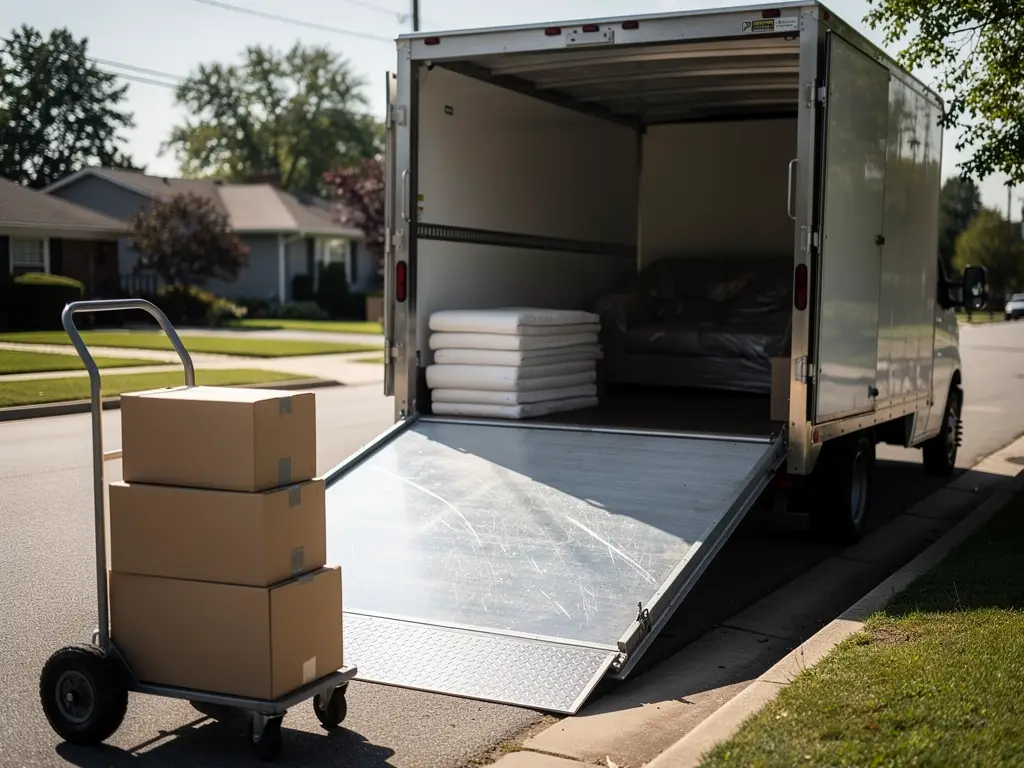
Plenty of people rent a truck or order a pod and handle the driving themselves, then look for extra hands for the heavy lifting. If that is you, the loading matters as much as the lifting. A truck loaded well rides quietly and arrives in the same condition it left. A truck loaded badly sounds like a drum set on every curve.
Before the first box goes in
Lay out your tools first. You will want a ramp or liftgate in place, a hand truck, moving pads or blankets, ratchet straps or rope, and a roll of stretch wrap for drawers and loose doors. Sweep the truck floor so nothing slides under the first items. Then stage everything near the door by size, with furniture in one group, big boxes in another, and small boxes in another. A loader who has to hunt for the next piece is a loader who throws things in wherever they fit.
Know your biggest pieces and load them first. Appliances, the dresser, the sofa, and the mattress get the best positions because they are the hardest to place later.
Heavy to light, bottom to top
Think of the load as a wall you are building from the floor up, going from the front of the truck, near the cab, back toward the door. Put the heaviest items on the floor and toward the front: the washer, the dryer, the fridge standing upright, tool chests, and boxes of books. Medium boxes and sturdy furniture come next. Light and fragile items go on top and toward the middle of the wall, with nothing heavy above them.
- Heavy appliances and tool chests go on the floor, against the front wall
- Dressers and bookcases stand upright with drawers and doors secured
- Mattresses and box springs stand on their long edge against a side wall, wrapped
- Sofas can stand on end or sit upright, padded where they touch metal
- Fragile boxes, lamps, and plants go on top of a solid layer, never on the bottom
Against the walls, then the middle
Start each tier on the sides of the truck and work toward the center. Furniture pressed to the wall has less room to rock, and the middle becomes a tight stack of boxes that holds the sides in place. Keep furniture flat against the wall instead of angled out. Pad any piece that touches metal or another piece of furniture, and tuck blankets between a wood edge and the one next to it.
Pods and containers work the same way, only the walls are closer. Because a pod is a box that gets lifted and driven by someone else, tight packing matters even more. Anything loose will slide when the container is moved, so make sure each layer is level before you start the next.
Fill every gap
Gaps are where loads shift. When a tier is mostly done, look for empty spaces between furniture and the ceiling or beside a dresser, and fill them with soft items: pillows, bags of clothes, folded blankets, cushions. A tight load moves as one piece. A loose one moves as many small pieces, and each one can bump into something breakable.
Keep some boxes of the same height together so each layer sits flat. Stack boxes with the heaviest on the bottom, and turn the labels outward so you can read them when it is time to unload.
Tie off in tiers
Do not wait until the truck is full to strap it. After each tier is complete, run a strap across it and cinch it to the wall rails or tie-down points in the truck. Straps pull the wall of boxes into the wall of the truck, and a tier that is tied off cannot lean forward onto the one in front of it. Work up one level at a time until you reach the top.
- Check the tie-down points in the truck before you start loading
- Pull each strap snug, then give it a second tug before you move on
- Cross-strap tall pieces like bookcases so they cannot tip
- Leave the last layer easy to reach, with the first things you need on top near the door
The last items in, usually your first-night box and a few essentials, should be the first ones out. Close the door, and then check the strap tension again after the first few miles of driving.
Unloading is the same job in reverse
Take the straps off the top tier first and work down. Unload the door end of the truck first, carrying the light items in while the heavy ones stay put until the path is clear. Bring the large furniture in early so you have space to walk.
Need strong hands without the truck?
B&M Moving and Cleaning Services offers loading and unloading only, so you can bring the rental and let a crew do the heavy part. The family-owned company is based in Ewing Township and works around Mercer County and Montgomery County, PA, across NJ, PA, and DE. Call or text (610) 299-1403 for a free quote, or read the Loading and unloading page on this site.
B&M Moving and Cleaning Services LLC, (610) 299-1403
Call (610) 299-1403More articles
A Room-by-Room Packing Order for Your Mercer County Move
Pack the rooms you will miss least first, label for where boxes are going, and keep one box for the first night.
Moving Out of a New Jersey Apartment: Stairs, Elevators, Parking, and the Last Walk-Through
Apartment moves are won or lost on logistics, so sort out the stairs, the elevator, and the truck before the day arrives.